|
 The
Coves del Collbato are located at Montserrat, a short journey
(40 minutes) to the north of Barcelona. The
Coves del Collbato are located at Montserrat, a short journey
(40 minutes) to the north of Barcelona.
The Collbato caves, revealed through
exploitation of sodium nitrate deposits, are found within the
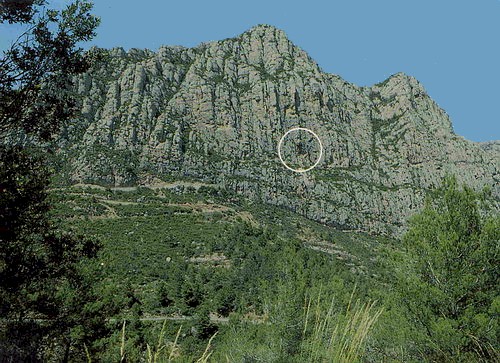
Montserrat massif, part of the Catalan pre-coastal range, and
date from the Tertiary era. Differential erosion and weathering
of this massif has led to the highly distinctive relief features
that can be seen in the photograph that forms the background to
this page.
The massif was once a delta of several rivers
draining into a shallow inland sea, occupying what is today the
Central Catalan Depression. The rivers deposited coarse, heavy,
well-rounded stones and cobbles, which become finer towards the
south of the massif, demonstrating characteristic deltaic
sorting.
During the Oligocene era, the elevation of the
land during the period that built the Alpine and Pyrenean
mountain ranges led to the creation of an inland lake. Earth
movements led to jointing of the rock which has had a decisive
influence upon the present day relief.
The pressure of overlying sedimentary layers
and earth movements created great heat which melted the skeletal
remains of sea and lake organisms that had accumulated in huge
quantities. This calcite ooze formed a strong cement binding
together the stone and cobble deposits to create the
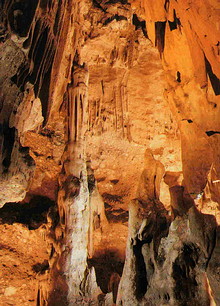
conglomerate we see today. This is spectacularly revealed inside
the caves.
The natural limestone of the conglomerates has
been slowly dissolved by rainwater, infiltrating the rock
through the joints before meeting layers of impermeable clay.
The general underground drainage direction is north and north
east, following the dip of the rock strata. This explains the
polarization of strangely carved outcrops to the north of
Montserrat.
The underground limestone scenery is found
above the watertable, particularly to the south of the massif.
The caves at Collbato served as an underground drain feeding an
ancient valley of the Salut torrent (now excavated by the
Llobregat river). Two different stages of the development of the
water level can be identified in the Pou del Diable pothole
inside the caves.
The caves are not as accessible as most, and
involve a 20 minute walk up a path that is well protected, but
steep in places.
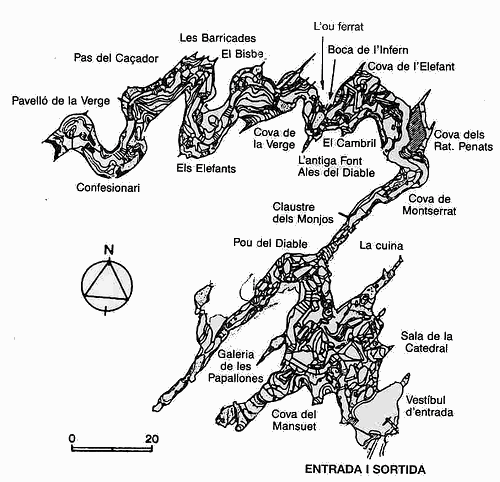
Brief description of the Caves
The caves are always a constant temperature of
14º, with a relative humidity of 97%.
La Cova de la Cathedral
This is some 60 metres in length and 35 metres
in height, with walls formed of great conglomerate blocks and
contains a small lake.
El Pou del Diable
This contains spectacular formations of
stalactites and stalagmites on a grand scale. The natural 25-30º
strike of the rock stata (dipping to the NE) can be clearly seen.
La Cova del Cambril o Columnes
This is possibly the most spectacular of all the
caves, rich in stalactite columns, with a slope indicating the
exit of water towards the south east.
|